Astraware Acrostic
- 4.4
- Rating
- 10.00K
- Installs
- Free
- Price

 Analysis by App-foxy
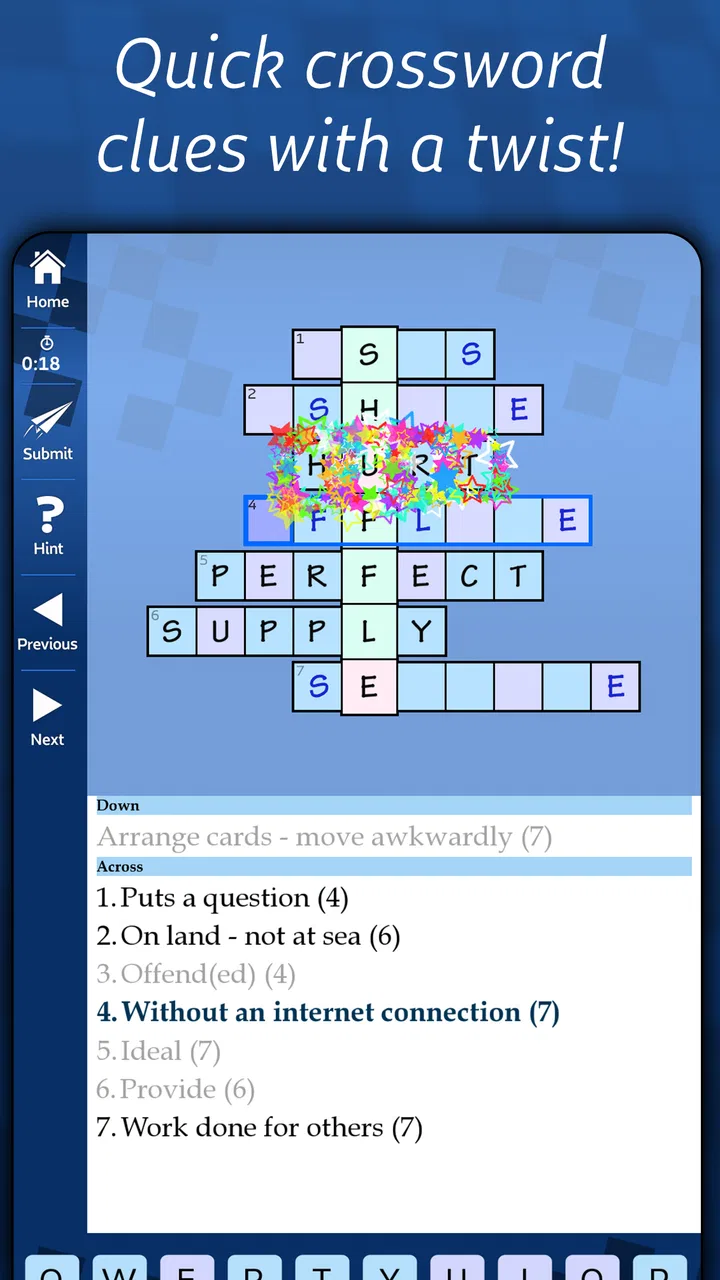
I approached Astraware Acrostic expecting a small word game for short breaks, and that is exactly where it fits best. It is a free crossword-style puzzle game from Astraware Limited, built around solving clues and using the answers to uncover a target word. The idea is easy to understand, but the way each clue feeds into the final answer gives every puzzle a satisfying second layer.
After spending time with it, I found the strongest appeal is its focused pace. This is not a sprawling adventure with characters, maps, or a long story to follow. It is a compact mental exercise that asks me to read carefully, make connections, and adjust my thinking when one answer affects the rest of the puzzle. For anyone who enjoys wordplay but does not always want a full-length crossword session, it has a useful place on a phone.
What the first puzzles ask you to do
The early goal is straightforward: solve the individual clues well enough to reveal the puzzle’s target word. That structure makes the game feel more purposeful than a collection of unrelated vocabulary questions. I am not simply filling answers for their own sake; I am gradually building evidence toward a final solution.
You May Also Like

 Blood Strike: 2.5 Anniversary
Blood Strike’s Loadouts Turn Every Drop Into a Tactical Gamble
A close look at Blood Strike’s custom loadouts: how fast access to signature weapons reshapes its battle royale rhythm, rewards preparation, and narrows the gap between fights.

 Pandora - Music & Podcasts
Pandora’s Music Is Easy to Start, but Harder to Recover
Pandora’s strength is its low-effort path from a seed to a station. Its weak spot is how much confidence it asks you to place in connection, setup, and quiet recovery.

 8 Ball Pool
 Is Built on Rivalries, Rematches, and Routine
A close look at the rivalries, rematches, shared routines, and unanswered safety questions that turn a quick pool match into a persistent mobile community.

 Samsung Music
’s Quiet Strength Is Playing What You Already Own
Its reach comes less from spectacle than from dependable access to a personal library. That simplicity is both the app’s strongest retention engine and its ceiling.

 AccuWeather: Weather Radar
AccuWeather Review: A Quick, Clear Forecast for Everyday Decisions
For everyday plans, the best forecast is the one you can understand quickly. AccuWeather makes rain timing, radar, and local conditions easy to act on, with a few trade-offs.

 Hill Climb Racing
Why Hill Climb Racing Still Turns Crashes Into One More Run
A tiny car, a bumpy hill and one more upgrade: Hill Climb Racing keeps resurfacing because its simple chaos makes every near-miss feel personal.
More From Our News Desk
View All News


That final target changes how I approach uncertain clues. In a normal crossword, I might leave a difficult entry blank and move on. Here, the letters already placed around it can suggest what the target word might be, which then helps me reconsider the clue. The game creates a small loop between local answers and the larger objective.
I particularly like that the basic objective does not need a tutorial-heavy explanation. A player who understands ordinary clue solving can begin quickly, while someone less familiar with acrostic puzzles can learn through the arrangement itself. The rules are simple enough for casual play, but the relationship between clues and the target word gives the format more depth than a basic word scramble.
In everyday use, I can imagine opening it while waiting for a coffee, taking a few minutes during a commute, or playing one puzzle before bed. It does not demand that I remember a complicated control scheme or keep track of a large inventory. The mental effort is concentrated on language, deduction, and recognizing when an answer fits the wider pattern.
How progress feels without unnecessary clutter
The clearest progress signal is the puzzle itself becoming more complete. Each accepted answer reduces uncertainty, and the emerging target word gives me a visible sense that I am moving somewhere. That matters in a word game because solving a single clue can otherwise feel disconnected from the overall experience.
I also found that partial progress has value even when I do not finish immediately. Solving the easier clues first creates a framework for the harder ones. Instead of staring at one stubborn definition, I can use the letters already established to narrow down possibilities. This makes the game feel less dependent on instantly knowing every answer.
That design is helpful for players who enjoy a measured sense of discovery rather than constant rewards or flashy feedback. The satisfaction comes from recognizing the pattern and watching the target word become plausible. It is a quieter kind of progression, but it suits the subject matter.
There is also a practical benefit to this structure: a puzzle can be approached in different orders. I do not have to solve clues from top to bottom. I can pick the entries that look familiar, use them as anchors, and return to the less obvious clues later. My most effective routine was to fill the obvious answers first, then look at the letters they contributed before making guesses on the remaining entries.
One useful tip is to avoid treating an uncertain answer as permanent just because it seems to fit the clue. In an acrostic puzzle, a nearly correct word can make the rest of the board feel confusing. When several later answers stop making sense, I found it better to revisit the earliest doubtful entry rather than forcing more guesses around it. That habit reduces wasted effort and makes the solving process feel more logical.
The difficulty curve and the value of uncertainty
The challenge comes less from complicated controls and more from language itself. A clue may have an obvious answer, a less common synonym, or wording that requires me to think beyond the first interpretation. Because all the answers contribute to a larger target, difficulty can appear in two ways: a clue may be hard on its own, or it may be difficult because I have not yet understood the pattern around it.
That distinction is important. When I am stuck, I do not always need a bigger vocabulary. Sometimes I need to step back and inspect the letters already available. Other times, the target word may be suggestive but not decisive, so I must resist choosing an answer simply because it helps the final pattern. The game rewards careful checking rather than random trial and error.
I would describe the challenge as better suited to players who enjoy thinking slowly than to people looking for rapid-fire word matching. It can be relaxing, but it is not mindless. A short session may contain a few quick successes followed by one clue that holds up the entire puzzle. That uneven rhythm is part of the appeal for me, although players who want constant momentum may find it frustrating.
Another concrete strategy is to separate clue confidence from target-word confidence. I might be fairly sure of the final word while still having one incorrect clue answer, or I might know several clues without understanding the target. Keeping those two judgments separate helps prevent overconfidence. I found the best results came from using the target as a guide, not as proof.
The game also works well for people who like vocabulary practice without the pressure of a timed contest. I can focus on why an answer works, notice alternative meanings, and build familiarity with clue styles. It is not a formal language course, but it can be a pleasant way to exercise word recognition and deduction during spare moments.
What keeps the puzzles interesting over time
The retention appeal is the desire to complete the next pattern, not a heavy layer of external rewards. Each puzzle offers a contained problem with a clear endpoint, and the target word gives the solving process a natural payoff. I often felt tempted to continue after finishing one because the next challenge promised the same satisfying combination of clue work and deduction.
That approach is more restrained than many modern mobile games. There is no need for me to manage a character, collect equipment, or follow a narrative campaign. The reason to return is simply that I enjoy solving another word structure. For the right audience, that is enough; for players who need social competition, dramatic unlocks, or constant audiovisual stimulation, it may not be.
The free entry point makes it easy to test that relationship with the game. It is listed for Everyone, so its subject matter is broadly accessible, and it does not present itself as a niche puzzle reserved for expert crossword players. At the same time, accessibility should not be confused with effortless play. A family member who likes word games can understand the objective quickly, but individual clues may still challenge younger or less experienced players.
Optional spending is part of the experience, with in-app items priced from $0.99 to $7.99. I would treat those purchases as a convenience decision rather than a reason to begin playing. The core appeal is the solving itself, so anyone considering a purchase should first decide whether they enjoy the clue-and-target format. If I were recommending it to a friend, I would suggest trying the free version long enough to see whether the puzzle rhythm feels rewarding before paying for anything.
One limitation is that this focused design can become repetitive if I am not already interested in word puzzles. Since the central activity remains clue solving, there is no broader genre shift to refresh the experience. That consistency is a strength for dedicated players and a weakness for anyone hoping for varied mini-games. I would skip it if my priority were action, visual exploration, or a strong story.
Where it fits among word-game alternatives
Compared with a traditional crossword, the target-word structure gives me an extra layer of guidance. A standard crossword may feel more open-ended because each clue and crossing answer must gradually support the whole grid. Here, the target provides another source of information, which can make the puzzle feel more approachable while still leaving room for deduction.
Compared with a simple anagram or daily word challenge, it asks for more sustained reasoning. I am not only rearranging letters or guessing one answer from a short prompt. I am managing several clues whose answers influence a larger result. That makes it a better choice when I want a compact puzzle with some internal structure, rather than a quick vocabulary reflex test.
On the other hand, players who prefer a strict daily routine may favor a game built around one clearly scheduled challenge. This title is more appealing when I want to choose my own session length and work through the puzzle logic at my own pace. It also suits players who like returning to an unfinished problem instead of starting over with a new format every time.
Its technical requirements are modest: the current version is 2.93.001 and it supports devices running iOS 9 or later. That makes it a practical option for people using an older compatible device, although I would still judge the experience mainly by whether the screen is comfortable for reading clues and entering answers. Word games depend heavily on clear text, so a small display may make longer sessions less pleasant even when the game itself runs properly.
The game has an average rating of 4.4 from around 232 ratings, with roughly 52 written reviews, and it has passed 10K+ installs. Those figures suggest a modest but positive audience rather than a huge mainstream phenomenon. I read that as a reason to set expectations correctly: this is a specialized, carefully focused word game, not a massive social platform with an endless stream of community content.
A realistic session and a few practical habits
Imagine I have ten minutes before an appointment. I can begin by scanning every clue and answering the ones that feel immediate. Rather than spending the entire break on the first difficult definition, I use the confirmed letters to identify likely patterns in the target. If one answer still feels uncertain, I mark it mentally as provisional and move to another clue that can provide stronger evidence.
If I return later, I do not need to reconstruct a complicated strategy. I can look at the incomplete entries, review the target letters, and test alternative interpretations. This makes the game suitable for interrupted play. It is especially useful for people who want a puzzle that can be paused naturally instead of one that penalizes them for stepping away.
My second habit is to read clues for grammatical signals, not just definitions. Whether an answer should be a noun, verb, or descriptive word can narrow the possibilities before I even consider the letters. My third is to use the target as a confirmation tool only after checking the clue. That order keeps the puzzle from turning into blind guessing and preserves the satisfaction of solving it properly.
These habits also reveal the main trade-off. The game rewards patience and attention, but it does not remove the possibility of a genuine vocabulary gap. If a clue uses a word I do not know, the target pattern may help me infer it, yet I may still need time to feel confident. Players looking for a completely frictionless experience should choose a simpler word game instead.
My verdict on the overall progression
Astraware Acrostic succeeds because its progression is built into the act of solving. The early goal is clear, the emerging target provides a useful progress signal, and the difficulty comes from combining clue knowledge with pattern recognition. It does not need elaborate unlocks to create momentum; the next completed puzzle is the main reason to continue.
That also defines its limits. The experience is narrow by design, and its appeal depends almost entirely on whether I enjoy crossword-style word reasoning. Someone looking for a broad mobile game with varied systems should look elsewhere. Someone who likes quiet, self-contained puzzles will find a more convincing reason to return, especially if they enjoy using partial answers to unlock the final word.
Astraware Limited has kept the concept approachable without making it empty. I appreciate that a short session can still feel meaningful, while a difficult clue gives me a reason to stay with the puzzle longer. The free price makes trying it low-risk, and the Everyone rating makes it easy to recommend across a wide range of players, with the reminder that optional purchases range from $0.99 to $7.99 per item.
My recommendation is simple: choose it if you want a focused word puzzle that rewards careful deduction, and skip it if you need action, story, or constant variety. For me, its best quality is the way a handful of ordinary clues gradually becomes one satisfying answer. That is a small idea, but it is strong enough to support repeated short sessions when the format matches my mood.
FAQs for Astraware Acrostic
01What is Astraware Acrostic and how is it played?
Astraware Acrostic is a word puzzle game built around acrostic-style clues. You solve a series of related definitions and use the answers to reveal a quotation, phrase, or hidden message. The game combines vocabulary, deduction, and pattern recognition, so it feels more involved than a basic crossword. It is suitable for players who enjoy thoughtful puzzles rather than fast arcade gameplay.
02Is Astraware Acrostic suitable for beginners?
Yes, beginners can enjoy Astraware Acrostic, although some puzzles may require patience and a reasonably broad vocabulary. The clue structure becomes easier to understand after completing a few examples, and players can work through puzzles at their own pace. It is also a good choice for experienced word-game fans who want more challenging clues and longer sessions of logical deduction.
03Does Astraware Acrostic work offline?
Astraware Acrostic is designed primarily as a self-contained puzzle experience, so many of its core features can generally be used without a constant internet connection. This makes it convenient for travel, commuting, or relaxing in places with limited connectivity. However, internet access may still be required for downloading the app, receiving updates, or using any platform-related services.
04Are there hints or assistance options in Astraware Acrostic?
The game includes assistance intended to help when a clue becomes particularly difficult, making the experience less frustrating for players who are stuck. Hints may reduce the challenge slightly, so experienced solvers can choose to avoid them while newcomers can use them to keep progressing. The availability and cost of specific assistance options can depend on the version and device platform.
05Is Astraware Acrostic free to download, and does it contain purchases?
Astraware Acrostic may be distributed as a paid app or with platform-specific purchase options, depending on whether you download it for Android or iOS and which store listing is available in your region. Before installing, check the current store page for the exact price, advertising information, and any optional in-app purchases. This is especially important if you prefer a completely free puzzle experience.
Pros
- Large puzzle library offers plenty of content for regular players.
- Clear interface makes clues and letter placement easy to follow.
- Works well for relaxing
- low-pressure offline puzzle sessions.
- Helpful hints can assist without completely solving the puzzle.
- Suitable for both quick breaks and longer focused play sessions.
Cons
- Some puzzles may feel repetitive after extended play.
- The smaller screen can make longer clue lists tiring to scan.
- Hints may reduce the challenge for experienced word-puzzle fans.
- Progress can feel slow when several clues depend on one answer.
- Players seeking competitive multiplayer features may find it limited.

Astraware Acrostic
Gallery